
Category Archives: Rittman Mead
Presentation Downloads, Links and Photos for the RM BI Forum 2012
Well the two BI Forum 2012 events in Brighton, and in Atlanta, are both now over, and as usual we’re now making the presentations available for download. Thanks again to all of the speakers, and in particular Kevin McGinley who provided the masterclasses, for putting the time in to create these presentations and share their knowledge at the two events. If you missed them when they were posted, here’s the two blog posts recapping Brighton and Atlanta 2012:
- The Rittman Mead BI Forum 2012 : Brighton’s Over, Now off to Atlanta!
- Week Two of the RM BI Forum 2012, in Atlanta
All presentations are in PDF format and, unless otherwise stated, are copyright of their respective authors/companies. Congratulations also to Emiel van Bockel and Jordan Meyer, winners of the best presentation awards for Brighton and Atlanta respectively, and to Antony Heljula and John Minkjan, who tied for best speaker in the 10-minute session category in Brighton.
Kevin McGinley Masterclass slides:
- The Action Framework : A Practical Guide to the Galaxy
- Oracle Scorecard & Strategy Management : The Un-Scorecard Manual
- Oracle BI Mobile : Where are we Now?
- OBIEE 11g Customized : Beyond the Whitepaper…
These are the presentation slides from the rest of the conference, from both Brighton and Atlanta:
- Alan Lee, Matt Bedin, Oracle Corporation : “RM BI Forum 2012 Opening Keynote”
- Steve Devine, Hitachi Consulting : “Effective Dashboard Design”
- Antony Heljula, Peak Indicators, “OBIEE 11g Security - It’s as Easy as 1-2-3″
- Adam Ferarri, Oracle Corporation : “Introducing Endeca Information Discovery”
- Tony Selden, PlayTech (Virtue Fusion) : “Whistlestop tour of a greenfield DW/BI Development (…When you really don’t need an ETL tool)”
- Daan Bakboord, Ebicus : “Oracle BI Applications: Can we make it worth the Purchase?”
- Antony Heljula, Peak Indicators : “Disabling your session logs will make no difference!”
- Mike Vickers, Rittman Mead : “The Rise of the Data Scientist”
- Ayse Oztop, GTech : “You Can’t Improve What You Don’t Measure”
- Adam Seed, James Coyle, John Holifield, Rittman Mead / Nominet : “BI Reporting Pack in the Real World”
- Adam Bloom, Oracle Corporation : “Oracle BI 11g Diagnostics”
- Emiel van Bockel, Centraal Boekhuis : “Go agile all the BI way”
- Mike Durran & Mark Rittman, Oracle Corporation/Rittman Mead : “Exalytics – All you ever wanted to know”
- Chris Webb, Crossjoin Consulting : “Introduction to the Microsoft BI Stack from a Microsoft MVP”
- Michael Wilcke, sumIT AG : “From reports/spreadsheets to OBI”
- Tim/Dan Vlamis, Vlamis Software Solutions, Inc. : “Data Visualization in Oracle BI 11g”
- Sunil S Ranka, FCS : “Deep Dive in OBIEE 11g Performance Tuning”
- Rene Kuipers, VX Company : “Groups, Roles and Issues”
- Stewart Bryson, Rittman Mead : “Reporting Against Transactional Schemas with OBIEE 11g”
- Matt Bedin, Phillipe Lions : “Real-Time / Low Data Latency Analytics with Oracle BI and Oracle Exalytics In-Memory Machine”
- Mark Rittman, Rittman Mead : “Inside Oracle Exalytics and Oracle TimesTen”
- Dan Vlamis, Vlamis Software Solutions, Inc : “OLAP Is Different From What You Think”
- Jordan Meyer, Rittman Mead : “Designing Eye-Catching and Effective Dashboards” and in web-based, interactive format (press right-arrow on keyboard to page through)
- Ramke Ramakrishnan, MarketSphere : “A Deep Dive into OBIEE 11g Security”
Finally, I put together two Flickr photo sets of the Brighton, and Atlanta, events, which you can access here:
Thanks again to everyone who attended, spoke or helped organize the event. Now to start planning 2013!
OBIEE performance tuning myth : BI Server logging
One of the frequent recommendations around performance in OBIEE that one hears is a blanket insistence on disabling the BI Server log. It is a line that is repeated by Oracle support, propogated in “Best Practice” guides, and repeated throughout blog posts on the subject. Antony Heljula did a talk on the subject at the recent RittmanMead BI Forum in Brighton, and I would like to echo and expand on it here.
The Myth:
If you are having performance problems in OBIEE, you should switch off BI Server logging
The arguments for:
- Instinct would tell us that writing a log is going to take longer than not writing to a log
- On a system with high user concurrency, we would expect to see contention for writing to the log file
- Usage Tracking records report response times, so why do we also need the server logging
- Log files will cause the disk to fill up, which left uncontrolled could cause system instability
The arguments against:
- If you have performance problems in OBIEE, then you need logging in place to be able to trace and diagnose them. The BI Server log gives us vital information such as what physical SQL results from a logical query from the front end. If you turn off logging, you lose all visibility of query behaviour, timings, and row counts.
- OBIEE writes lots of logs, more so now in 11g. Why only disable one of them? Why not all logs?
- If a query takes 30 seconds to run, how much of that 30 seconds is actually going to be in log overhead? You disable logging and now your query runs in 29.999 seconds. It’s still slow, it’s still a performance problem - and now you don’t have the data available with which to diagnose the problem!
- Usage Tracking doesn’t record the same level of detail around a query’s behaviour (response time profile, row counts) that the server log does.
- By default, Usage Tracking chops off Logical SQL above 1024 characters in length.
- Sometimes you need the log file to confirm that Usage Tracking is reporting correctly (especially in circumstances where report run times seem unusually high)
- Error messages returned from the database are not captured in Usage Tracking
It Depends
To a point, I am being contrary in arguing this specific issue, but it is important with this and other broad-stroke pronouncements around performance that get regurgitating without context and caveats that they are understood. In particular, labelling it a “Best Practice” is a dangerous fallacy as it implies that it should be done without much further thought or consideration of its consequences.
If the NFR for a report’s performance is [sub]-second and it is not being met, then profiling of the end-to-end response time breakdown should be done, and it might be that it demonstrates that the logging is impeding performance. But the point is that it is proven rather than done blindly.
Further reading
Cary Millsap’s paper, Thinking Clearly About Performance, is an excellent starting point for developing an understanding of a logical and methodical approach to performance problem solving.
James Morle wrote an great blog post on the subject of “Best Practice” and why it is dangerous terminology, entitled “Right Practice”
Thanks to Tony for reviewing & making further suggestions for this article.
Public training schedule for 2012-H2 announced
Rittman Mead offer training courses at centres in Brighton UK, Atlanta GA, Bengaluru India, and Melbourne Australia. These courses are our standard, “bootcamp” courses, five days in length, and is typically taught by consultants such as Mark Rittman, Robin Moffatt, Stewart Bryson, Ashley Beauman and Venkatakrishnan J.
If you’ve wanted to attend one of our courses but your company didn’t want to train up an entire team, here’s your opportunity to learn Oracle BI from the experts!
We are pleased to announce the following new dates for our popular public training courses in the UK, India, and Australia. Dates for America will follow shortly:
TRN202 : OBIEE 11g Bootcamp (5 days) Prices: £2000 + VAT (UK), US$ 3,250 (USA), Rs. 44,000 (India), AUD 3,250 + GST (Australia)
- 11th - 15th June, Brighton UK

- 11th - 15th June, Bengaluru India
- 9th - 13th July, Bengaluru India
- 23rd - 27th July, Melbourne Australia
- 6th - 10th August, Bengaluru India
- 13th - 17th August, Brighton UK
- 10th - 14th September, Bengaluru India
- 8th - 12th October, Brighton UK
- 8th - 12th October, Bengaluru India
- 12th - 16th November, Bengaluru India
- 10th - 14th December, Brighton UK
- 10th - 14th December, Bengaluru India
TRN205 : Oracle BI EE 11g Create Reports, Dashboards, Alerts and Scorecards (2 days) Prices: £800 + VAT (UK), US$ 1,300 (USA), Rs. 17,600 (India), AUD 1,300 + GST (Australia)
- 23rd August - 24th August, Melbourne, Australia
TRN 403 : Oracle Data Integrator 11g Bootcamp (5 Days) Prices: £2000 + VAT (UK), US$ 3,250 (USA), Rs. 44,000 (India), AUD 3,250 + GST (Australia)
- 11th - 15th June, Atlanta GA
- 16th - 20th July, Bengaluru India
- 30th July - 3rd August, Brighton UK
- 17th - 21st September, Bengaluru India
- 24th - 29th September, Melbourne Australia
- 29th October - 2nd November, Brighton UK
TRN303 : Oracle Business Intelligence Applications 7.9.6.3 Bootcamp (3 Days) Prices: £2000 + VAT (UK), US$ 3,250 (USA), Rs. 44,000 (India), AUD 3,750 + GST (Australia)
- 20th - 22nd August, Bengaluru India
- 15th - 17th December, Bengaluru India
Don’t forget, there is a 10% discount for UKOUG members. For more information, or discuss your training requirements in detail, please email us.
UKOUG Conference Call for Papers – Just Two Weeks Left!
Although it’s great fun to travel the world speaking at events such as Oracle Openworld, Collaborate and ODTUG KScope, Rittman Mead in the UK still consider the UK Oracle User Group Conference, held in Birmingham in November or December each year, to be our “home” conference and our main showcase for what we’ve been up to in the last year. Like most of the big annual conferences, the UKOUG event has multiple streams and the one we’re particularly interested in is the Business Intelligence and Data Warehousing stream, covering topics and products such as OBIEE, ODI, Essbase and Oracle OLAP, BI methodologies and the BI Applications.
Jon Mead is on the board of directors for the UKOUG, and both Jon and I have chaired the Business Intelligence & Reporting Tools SIG within the UKOUG in previous years. I’m particularly keen that we get some good, new and in-depth content around Oracle BI, DW and ETL for this year’s event, and I’d imagine papers on the following topics might go down well:
- OBIEE development methodologies and best/right practices
- OBIEE metadata modeling techniques, particularly against OLTP sources, OLAP sources and federating disparate data sources
- Dashboard design best practices, and anything around effective / innovative visualizations
- Presentations around data mining, Oracle R, big data and Hadoop
- Tips and techniques around ODI, including migrations from OWB and Informatica
- Papers around mapping, mobile, scorecards or any of the other OBIEE extensions introduced with 11g
- Techniques to get the best out of the BI Apps, including handling upgrades, preparing for the Fusion Apps, and combining packaged data models with custom ones
I’ll be putting a paper in on real-world use of the Exalytics In-Memory Machine, based on testing we’ll be doing over the summer along with feedback from customer PoCs. All speakers get a three-day pass to attend all of the other sessions, and if you get accepted you’ll be presenting at Europe’s biggest Oracle conference as well as knowing you’re contributing to a great event. There’s also a number of great social events and awards over the three days of the conference, and the photo below is of Debra Lilley (UKOUG President) and Lisa Dobson (Vice President) giving the awards whilst Vikki Lira (OTN and the ACE Program) stands in the foreground.
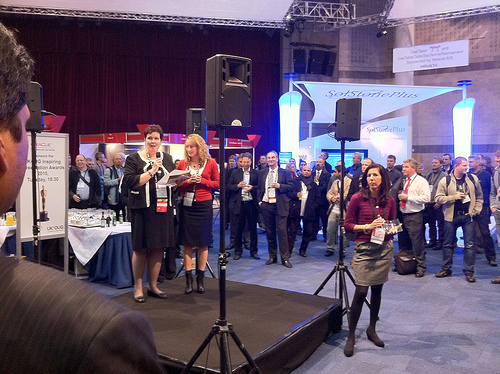
The call for papers website is here, and you’ve got until the 1st of June to get your abstracts in. Hopefully I’ll see some of you attend, and maybe present,
Week Two of the RM BI Forum 2012, in Atlanta
I’m just back now from Atlanta, having been over there for the past week helping run the second week of the RM BI Forum 2012. Around 55 BI professionals from around the USA (and with a few from Europe) got together over four days to network, share tips and techniques around Oracle BI development, meet the Oracle PMs, and enjoy themselves downtown in Atlanta, GA.
The format of the US BI Forum followed the same structure as the UK one, with Kevin McGinley providing the masterclass on the Tuesday, the main conference running on Wednesday and Thursday, and the NDA BI Developer day on the Friday organized in conjunction with Oracle. Kevin’s session was if anything even better received than in Brighton, with topics ranging from the Action Framework through Oracle Scorecard & Strategy Management, UI customization and of course BI Mobile. Thanks again to Kevin for taking the time to develop the materials, and then join us over two weeks to deliver the masterclass and then take part in the event itself.
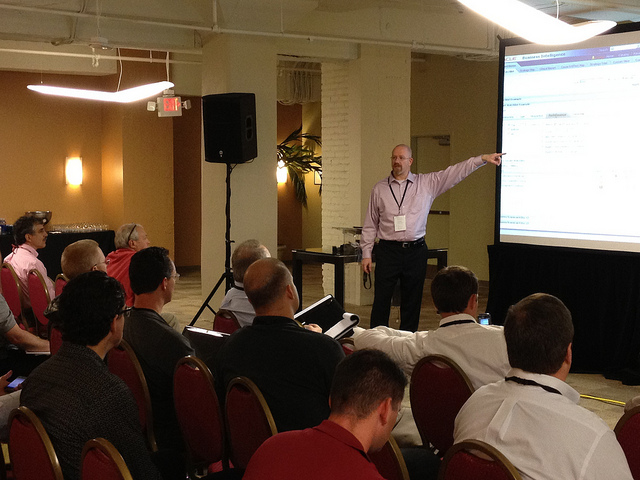
The main conference then kicked-off with Tim and Dan Vlamis talking about dashboard best practices, then went on to cover Endeca, OBIEE performance tuning, security, Exalytics, RPD data modeling, big data and the new 11.1.1.6.2 SampleApp. As with Brighton, we ran a number of 10-minute sessions over the two days, including some Ignite-style sessions that had slides that auto-advanced every thirty seconds, and TED-style sessions where the speaker covered a controversial or counter-intuitive topic with minimal slides and sometimes props. Here’s Christian Screen, from Cap Gemini and ArtofBI.com, delivering his Ignite session on how to become an Oracle ACE.
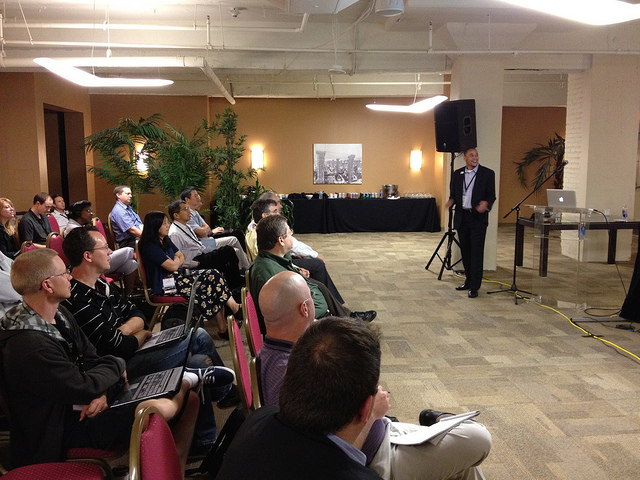
The Best Presentation Award went in the end to our own Jordan Meyer, who talked about the wider world of data visualizations including examples such as the Billion Dollar Gram, a facebook network visualization created using R, and other examples created using Oracle’s R toolkit and embedded in Oracle BI dashboards. Jordan had a great relaxed but engaging presenting manner, covered some hot new technology and even managed to create a visualization based on Stewart’s comments about Apple on our internal mailing list, shown in the photo below along with the subject.
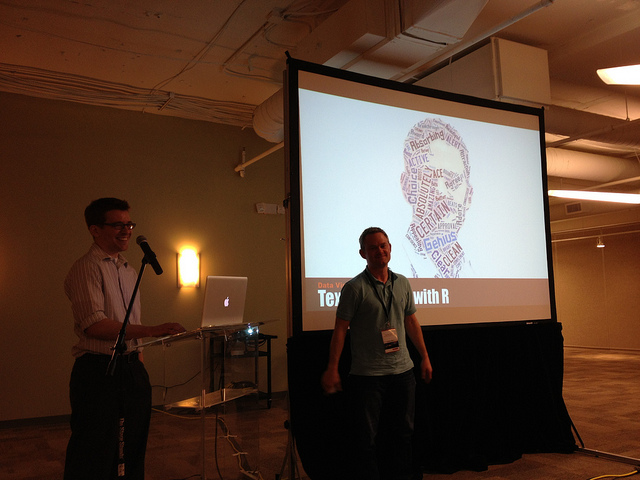
Although the event is primarily community organized, we had some exceptional support from the Oracle BI product management/development team again this year in Atlanta, including Matt Bedin who heads-up developer outreach for Oracle BI, Philippe Lions who demonstrated the new 11.1.1.6.2 SampleApp and provided a beta version for delegates to take away with them, and Pravin Janardanam who recently joined the product management team and is responsible for the metadata elements of the BI Server. We were also privileged to be joined for the second year by Jean-Pierre Dijcks who ran a whiteboarding session on big data, and Adam Ferrari, ex-CTO of Endeca who talked about the Oracle Endeca Information Discovery platform and analyzed, live, the tweet stream from this week’s, and the previous week’s, attendees. Thanks again to everyone from Oracle, especially for staying around for all four days and taking part in all of the sessions.
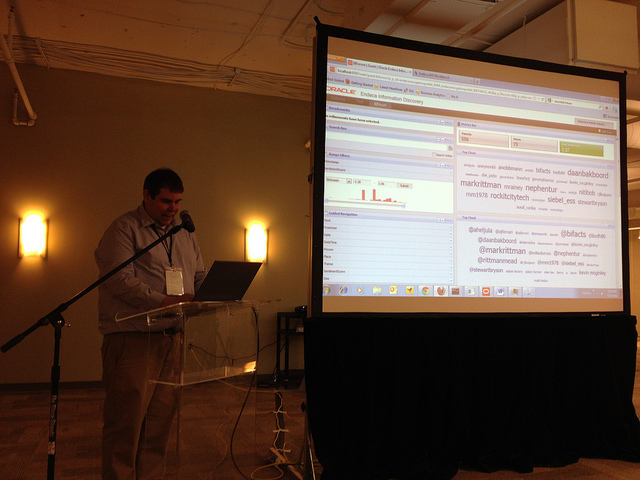
Friday, as with the Brighton week, was a special BI Developer day organized in conjunction with Oracle BI product development and held under NDA (non-disclosure agreement), where we were taken through the product roadmap in more detail and looked in particular at a couple of significant changes/developments in the OBIEE product architecture. Of course I can’t go into any detail now, but thanks again to Oracle for this and watch this space for insight and analysis once things become public.
So that’s it for now. I’ll do one final blog post early next week to post all of the presentation PDFs, and photos from the US event can be viewed in this BI Forum Atlanta 2012 Flickr set. Thanks again to everyone, and no doubt we’ll start planning the 2013 event very soon!
 Specialist in liberating data into valuable information for the business.
  The technical engineers who know all about Oracle BI architectures
  The implementation partner for Exadata and Exalytics